Passa al contenuto
Product Guide

Types of Plasterboard: The Complete Guide for Queensland Builders

Standard, moisture-resistant, fire-rated, acoustic, impact-resistant and flexible plasterboard. Understand when each type is required, what the NCC expects, and which products we stock across our four South East Queensland branches.

Choosing the Right Board

Not All Plasterboard Is the Same

The correct board type depends on the application, the NCC requirements for the space, the finish level required, and the acoustic and structural demands of the project. Specifying the wrong board leads to compliance failures, callbacks and costly remediation.

This guide covers the six main types of plasterboard available from Bayside Plasterboard, the conditions where each is required or recommended, the brands we stock, and the technical specifications your certifier or engineer will ask for.

01 Standard plasterboard sheets stacked in the Bayside warehouse

Standard Plasterboard

Dry internal walls & ceilings

Also called regular or white board, this is the most widely used lining product in Australian residential and light commercial construction. A gypsum core encased in paper facing, suited to internal walls and ceilings where no special performance requirement applies.

Thicknesses
10mm ceilings and light partitions, 13mm standard walls and ceilings, 16mm higher impact and acoustic performance. Lengths 2400mm to 6000mm.
When to use
Bedrooms, living areas, corridors and offices. Not suitable for wet areas, fire-separation walls, or high-acoustic applications without overlay.
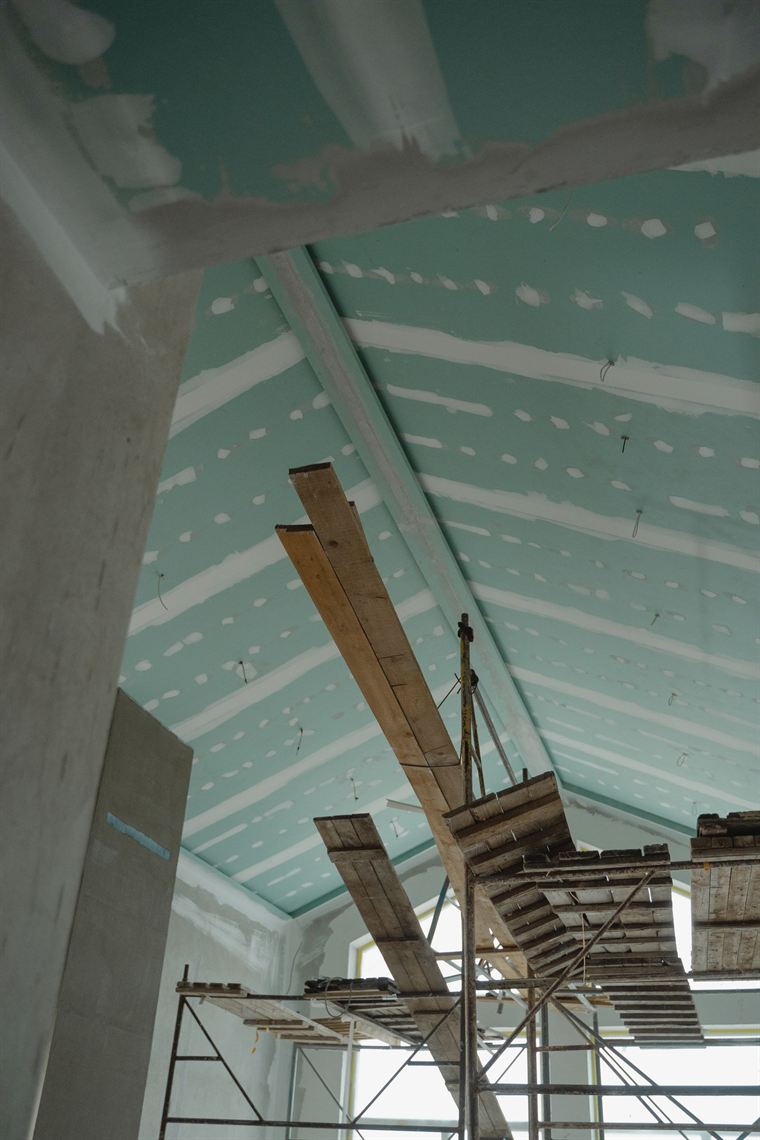
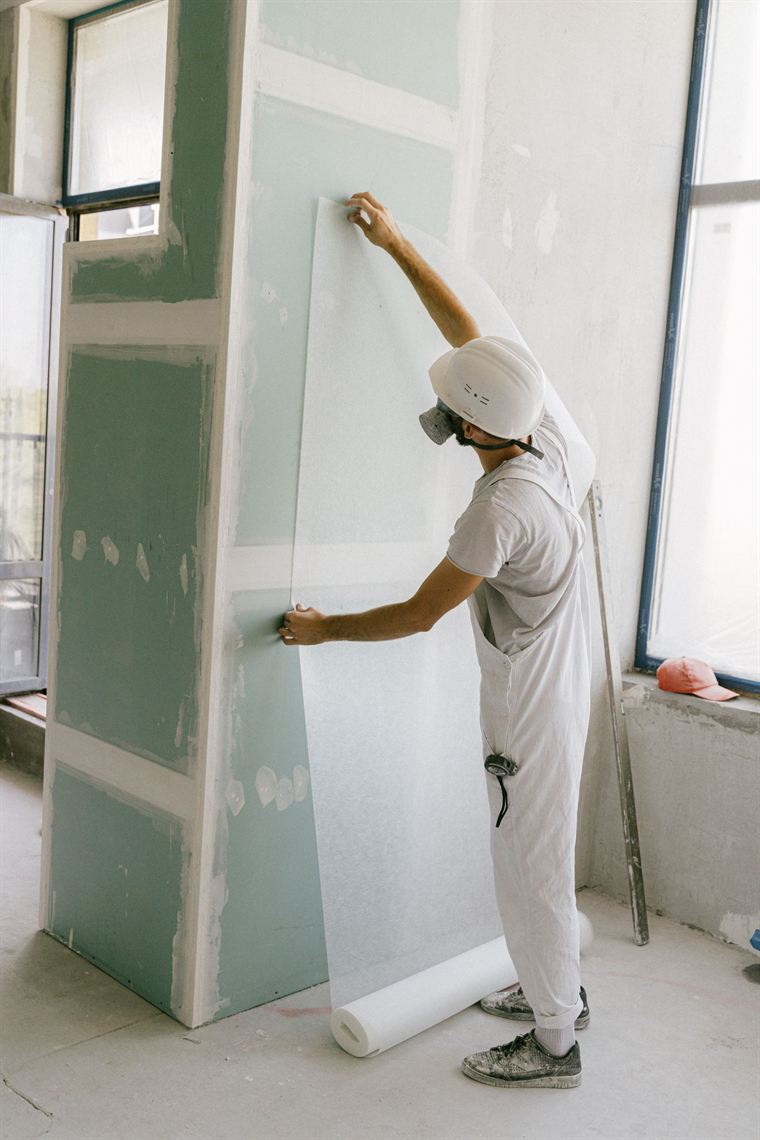
02 Green moisture-resistant plasterboard being fixed to ceiling framing

Moisture-Resistant (MR) Plasterboard

Bathrooms, laundries, splashbacks

A treated gypsum core and moisture-resistant paper facing that resists water vapour and occasional splashing. Required by NCC 2022 for wet area wall linings, where it provides the substrate for tiles or other impervious finishes.

Products
Knauf Moistureshield and Knauf Moistureshield, in 10mm and 13mm.
Important
MR board is not a waterproofing membrane. A separate membrane must be applied over it in shower recesses and floor-to-wall junctions per AS 3740.
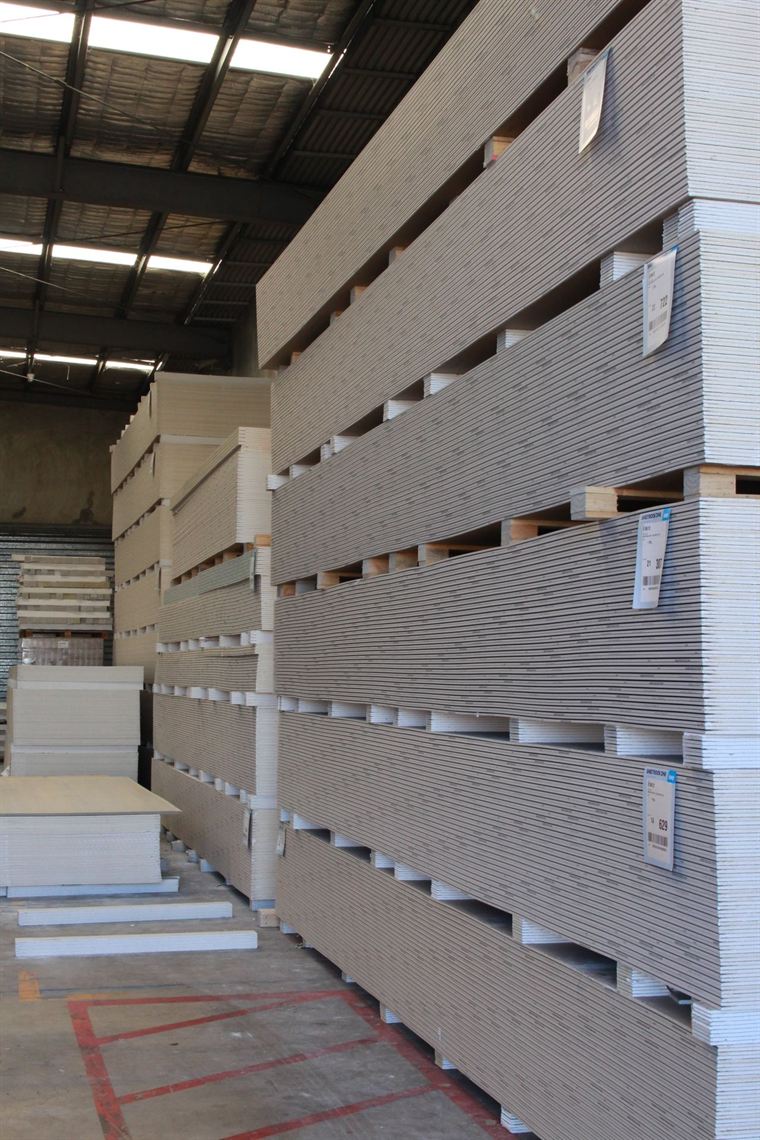
03 Pallets of fire-rated plasterboard stocked at Bayside Plasterboard

Fire-Rated Plasterboard

Party walls & compliance walls

A denser gypsum core with glass fibres that slows heat transfer and maintains structural integrity under fire conditions. Used in fire-separation walls and ceilings between dwellings, between garages and living spaces, and wherever the NCC requires a Fire Resistance Level.

Products
Knauf Fireshield and Knauf Fireshield, in 13mm and 16mm. Double-layer systems achieve FRL 90/90/90 and higher.
When to use
Anywhere the NCC prescribes an FRL: party walls in Class 1 and Class 2 buildings, and commercial fitout compliance walls.
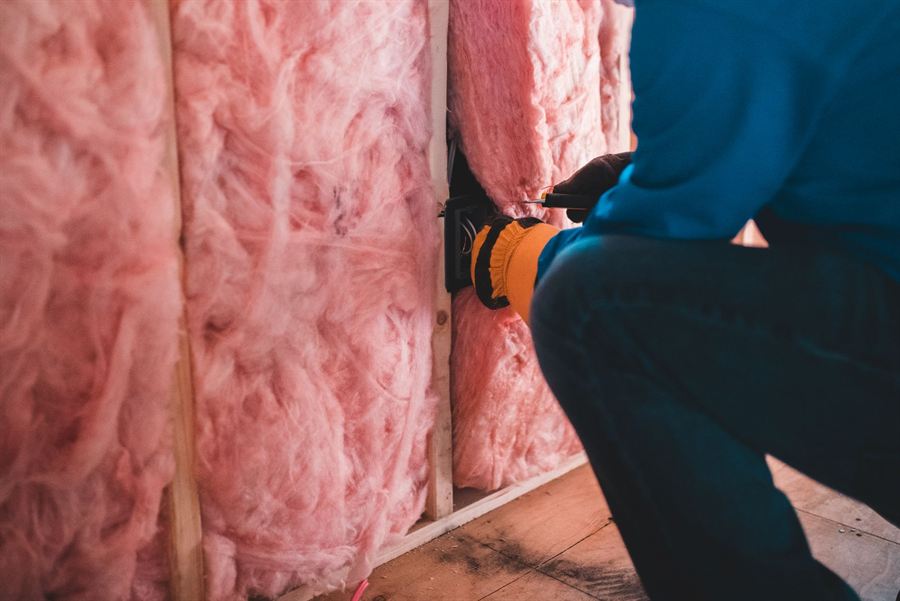
04 Acoustic insulation batts installed between wall studs

Acoustic Plasterboard

Multi-residential, hotels, offices

A denser core than standard board, improving Rw and Rw+Ctr ratings in party wall and floor-ceiling assemblies. It reduces airborne sound transfer between spaces and is specified in multi-residential buildings, hotels, offices and home theatre rooms.

Products
Knauf Soundshield and Knauf Soundshield, typically 13mm. High-performance systems double the layers with resilient mounts and Bradford Soundscreen batts.
When to use
The NCC sets minimum acoustic performance between dwellings in Class 2, 3 and 9c buildings. Also widely specified in commercial fitouts and hospitality.
05 Impact-resistant plasterboard being installed on a commercial wall

Impact-Resistant Plasterboard

High-traffic commercial

A reinforced core and heavier paper facing that significantly increases resistance to surface denting, cracking and penetration. Used in high-traffic commercial areas, schools, hospitals and corridors where knocks from carts, equipment and foot traffic are expected.

Products
Knauf Impact board and Knauf Impact, available in 13mm.
When to use
Commercial fitouts with high traffic, aged care facilities, schools and public buildings. Reduces long-term maintenance in high-use areas.
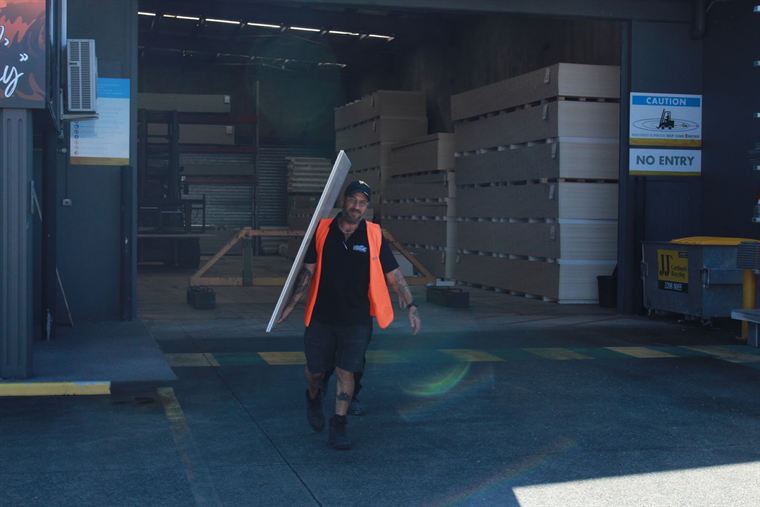
06 Bayside Plasterboard staff member carrying a plasterboard sheet

Flexible Plasterboard

Curves, archways, radius features

A thinner board, typically 6mm, that bends to form curved walls, archways and radius features without cracking or delaminating. Installed in two layers on curved framing: the first bent to shape, the second for finish quality.

Products
Knauf Flex and Knauf Flex, 6mm, in standard sheet lengths.
When to use
Curved walls, barrel vaults and archways, and any form needing a radius tighter than 13mm board can achieve. Contact your branch for current availability.

Not sure which board your job needs?

Our counter staff specify plasterboard systems every day. Call (07) 3245 4488 or visit your nearest branch and we'll walk you through product selection, system fire ratings, NCC compliance and acoustic performance for your specific application. Trade account holders get priority support.

How do the main types of plasterboard compare?

Five grades cover almost all Australian work: standard for general walls and ceilings, moisture resistant for wet areas, fire rated for tested fire separating systems, impact resistant for high traffic walls, and acoustic for sound rated construction. They share sheet sizes and install the same way, so the choice is driven by what the wall has to survive.

TypeCommon thicknessApprox. weightWet areasFire systemsTypical use
Standard10mm, 13mmapprox. 7 to 9 kg/m2NoNoBedrooms, living areas, corridors, offices
Moisture resistant10mm, 13mmapprox. 7 to 9 kg/m2Yes, under a compliant membraneNoBathrooms, laundries, kitchens
Fire rated13mm, 16mmapprox. 11 to 13 kg/m2NoYes, as part of a tested systemSeparating walls, shafts, garages
Impact resistant13mmapprox. 10 to 12 kg/m2NoCheck the systemCorridors, schools, healthcare, hospitality
Acoustic13mm, 16mmapprox. 11 to 13 kg/m2NoCheck the systemParty walls, home theatres, apartments

Weights are typical figures for comparison and for planning lifts. Confirm against the current data sheet for the product you buy. Fire and acoustic performance are properties of the tested system rather than of the sheet on its own.

What thickness plasterboard do I need for walls and ceilings?

10mm is the common wall thickness in Australian domestic work. 13mm is the usual choice for ceilings, because the wider batten spacing on a ceiling needs the extra stiffness to stay flat, and it is also preferred on walls where a flatter finish or better fixing holding is wanted. 16mm appears mostly inside fire and acoustic systems.

Check the stud or batten centres before you order. A board that is fine at 450mm centres can telegraph or sag at 600mm.

What drives the price of plasterboard sheets?

Grade is the biggest factor: impact resistant, acoustic and fire rated board cost more per square metre than standard. After that it is thickness, sheet length, brand, quantity and whether you collect or we deliver. We do not publish live trade rates because they move with volume and account terms.

For an impact resistant or acoustic price check, send the grade, sheet size and quantity and we will price it the same day. Request a quote or call (07) 3245 4488.

Where can I buy plasterboard sheets near me?

Bayside Plasterboard stocks plasterboard sheets at four trade yards across South East Queensland: Morningside in Brisbane, Chandler in the Redlands, Caboolture on the northside and Carrara on the Gold Coast. Collect from the counter or book a site delivery. Call (07) 3245 4488 to confirm stock at your nearest branch before you drive out.

BranchAddressTypically serves
Brisbane (Morningside)367 Thynne Road, MorningsideInner east, southside and Brisbane CBD sites
Redlands (Chandler)3/1424 New Cleveland Road, ChandlerRedlands, bayside and eastern corridor sites
Northside (Caboolture)10 Piper Street, CabooltureMoreton Bay, Morayfield, Bribie Island and Petrie sites
Gold Coast (Carrara)106 Eastlake Street, CarraraGold Coast and northern Gold Coast sites

We supply South East Queensland only. If your site sits outside Brisbane, the Redlands, Moreton Bay or the Gold Coast, call us and we will tell you honestly whether we can service it.

Common Questions

Plasterboard Types FAQs

What is the difference between standard plasterboard and premium grades?

Standard plasterboard suits dry internal spaces with no special performance requirement. Premium grades, meaning fire-rated, acoustic, moisture-resistant and impact-resistant, have modified cores or facings that deliver measurable performance in specific applications. The right choice depends on the NCC requirements for the space and the project specification.

What are the main types of plasterboard?

Standard for general walls and ceilings, moisture resistant for wet areas, fire rated for tested fire separating systems, impact resistant for high traffic walls, and acoustic for sound rated construction. They share sheet sizes and install the same way.

What thickness plasterboard do I need for walls and ceilings?

10mm is the common wall thickness in Australian domestic work and 13mm is the usual ceiling choice, because wider batten spacing needs the extra stiffness to stay flat. 16mm appears mostly inside fire and acoustic systems. Check your stud and batten centres before ordering.

How much do impact resistant plasterboard sheets cost?

Grade drives most of the difference: impact resistant, acoustic and fire rated board all cost more per square metre than standard. Thickness, sheet length, brand, quantity and delivery then apply. Send the grade, size and quantity and we will quote the same day on (07) 3245 4488.

Which plasterboard can be used in a bathroom?

Moisture resistant plasterboard, in 10mm or 13mm, or a fibre cement wet area sheet where the system calls for one. Neither is waterproof on its own, so a compliant waterproofing membrane is still required in the areas the standard nominates.

Can I use standard plasterboard in a bathroom?

No. NCC 2022 requires moisture-resistant plasterboard for wet area wall linings in bathrooms, laundries and kitchen splashback areas. Standard board deteriorates under ongoing moisture and is not an approved substrate for tiles in wet areas. Knauf Moistureshield are the correct products.

What board do I need for fire-rated walls?

Fire-rated walls need a gypsum board with a tested and certified Fire Resistance Level. Knauf Fireshield are the standard products. The FRL you need, whether 30/30/30, 60/60/60, 90/90/90 or higher, depends on the building class and the element being protected. Our team can advise on the correct product and layer count.

How thick should plasterboard be for ceilings?

10mm is the minimum for domestic ceilings on framing at 450mm centres. 13mm is recommended for ceiling spans at 600mm centres and resists sag better over time. For fire-rated ceiling systems, 13mm or 16mm fire-rated board is specified depending on the FRL required and whether the system is single or double layer.

Is acoustic plasterboard the same as soundproof plasterboard?

Acoustic plasterboard improves sound attenuation, but no single layer of board is truly soundproof. High-performance acoustic separation needs a system approach: acoustic board, resilient mounts, acoustic insulation batts and correctly detailed junctions. For NCC-compliant party wall systems, contact us for product recommendations and the Rw and Rw+Ctr ratings of the tested system.

Need Board on Site
This Week?

Tell us the job and we'll confirm stock, pricing and delivery.