Zum Inhalt springen

Types of Plasterboard — The Complete Guide for Queensland Builders

Standard, moisture-resistant, fire-rated, acoustic, impact-resistant, and flexible plasterboard — understand when to use each type and which products we stock.

Ask Our Team Brands We Stock

Choosing the Right Plasterboard for the Job

Not all plasterboard is the same. The correct board type depends on the application, the NCC requirements for the space, the finish level required, and the structural and acoustic demands of the project. Specifying the wrong board can lead to compliance failures, callbacks, and costly remediation.

This guide covers the six main types of plasterboard available from Bayside Plasterboard, the conditions where each is required or recommended, the brands we stock, and the key technical specifications your certifier or engineer will want to know.

If you are unsure which board type is right for your application, contact your nearest Bayside Plasterboard branch. Our team can advise on product selection, system fire ratings, NCC compliance, and acoustic performance requirements.

Standard Plasterboard

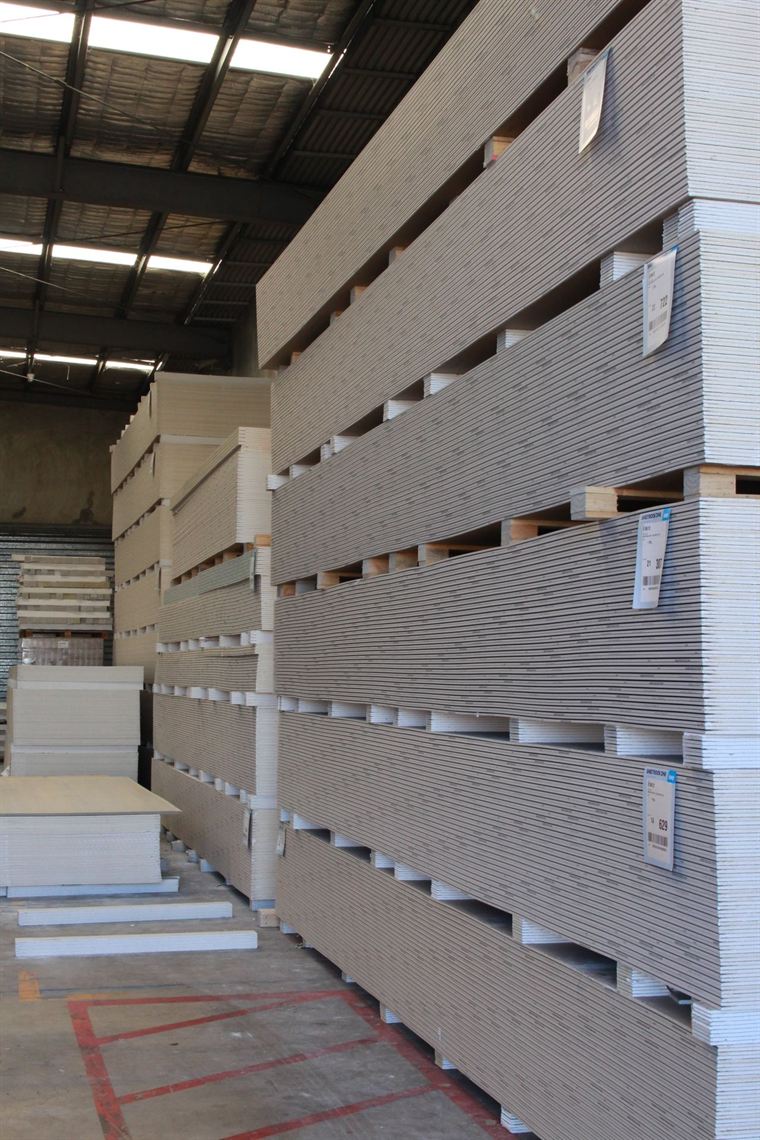
Standard plasterboard — also called regular or white board — is the most widely used lining product in Australian residential and light commercial construction. It consists of a gypsum core encased in paper facing and is suitable for internal walls and ceilings where no special performance requirement applies.

Common thicknesses: 10mm (ceilings, light partitions), 13mm (standard walls and ceilings), 16mm (higher impact and acoustic performance). Available from CSR Gyprock and Knauf in lengths from 2400mm to 6000mm.
When to use: Internal walls and ceilings in dry areas — bedrooms, living rooms, corridors, offices. Not suitable for wet areas, fire-separation walls, or high-acoustic applications without overlay or treatment.

Moisture-Resistant (MR) Plasterboard

Moisture-resistant plasterboard has a treated gypsum core and moisture-resistant paper facing that resists the passage of water vapour and occasional splashing. It is required by NCC 2022 for wet area wall linings — bathrooms, laundries, and kitchen splashback areas — where it provides the substrate for tiles or other impervious finishes.

Products: CSR Gyprock Aquachek, Knauf Moistureshield. Available in 10mm and 13mm thicknesses.
When to use: NCC-required wet areas. Not a standalone waterproofing membrane — a separate membrane must be applied over MR board in shower recesses and floor-to-wall junctions per AS 3740. See our dedicated MR Plasterboard Guide.

Fire-Rated Plasterboard

Fire-rated plasterboard has a denser gypsum core with glass fibres that slow the rate of heat transfer and maintain structural integrity under fire conditions. It is used in fire-separation walls and ceilings between dwellings, between garages and living spaces, and in commercial buildings where NCC requires a Fire Resistance Level (FRL) to be achieved.

Products: CSR Gyprock Fyrchek, Knauf Fireshield. Available in 13mm and 16mm thicknesses. Double-layer systems achieve FRL 90/90/90 and higher.
When to use: Anywhere the NCC prescribes an FRL — party walls in Class 1 and 2 buildings, commercial fitout compliance walls. See our detailed Fire-Rated Plasterboard Guide.

Acoustic Plasterboard

Acoustic plasterboard has a denser core than standard board that improves Sound Transmission Class (STC) ratings when used in party wall and floor/ceiling assemblies. It reduces the transmission of airborne sound between spaces and is used in multi-residential buildings, hotels, offices, and home theatre rooms.

Products: CSR Gyprock Soundchek, Knauf Soundshield. Typically 13mm. For high-performance acoustic systems, doubled layers with resilient mounts and Bradford Soundscreen insulation batts are used.
When to use: NCC requires minimum acoustic performance between dwellings in Class 2, 3, and 9c buildings. Also widely specified in commercial office fitouts and hospitality projects.

Impact-Resistant Plasterboard

Impact-resistant plasterboard has a reinforced core and heavier paper facing that significantly increases resistance to surface denting, cracking, and penetration from everyday knocks and impacts. It is used in high-traffic commercial areas, schools, hospitals, corridors, and anywhere frequent impact from carts, equipment, or foot traffic is expected.

Products: CSR Gyprock Toughchek, Knauf Impact. Available in 13mm. Typically used in corridors, lift lobbies, and facility management spaces.
When to use: Commercial fitouts with high traffic, aged care facilities, schools, public buildings. Impact board reduces long-term maintenance costs in high-use areas.

Flexible Plasterboard

Flexible plasterboard is a thinner board (typically 6mm) that can be bent to form curved walls, archways, and radius features without cracking or delaminating. It is installed in two layers on curved framing — the first layer bent to shape, the second layer for finish quality — and is used in both residential and commercial architectural feature work.

Products: CSR Gyprock Flexible, Knauf Flex. 6mm thickness, available in standard sheet lengths.
When to use: Curved walls, barrel vaults, archways, and any architectural form requiring a radius tighter than standard 13mm board can achieve. Contact your nearest branch for availability.

Plasterboard Types FAQs

Standard plasterboard is suitable for dry internal spaces with no special performance requirement. Premium grades — fire-rated, acoustic, moisture-resistant, impact-resistant — have modified cores or facings that provide measurable performance in specific applications. The right choice depends on the NCC requirements for the space and the project specification.

No. NCC 2022 requires moisture-resistant (MR) plasterboard for wet area wall linings in bathrooms, laundries, and kitchen splashback areas. Standard plasterboard will deteriorate when exposed to ongoing moisture and is not an approved substrate for tiles in wet areas. CSR Gyprock Aquachek or Knauf Moistureshield are the correct products for these applications.

Fire-rated walls require a gypsum board with a tested and certified fire resistance level (FRL). CSR Gyprock Fyrchek and Knauf Fireshield are the standard products. The FRL you need — 30/30/30, 60/60/60, 90/90/90, or higher — depends on the building class and the element being protected. Our team can advise on the correct product and layer count for your compliance requirement.

10mm plasterboard is the minimum for domestic ceilings on framing at 450mm centres. 13mm is recommended for ceiling spans at 600mm centres and provides better resistance to sag over time. For fire-rated ceiling systems, 13mm or 16mm fire-rated board is specified depending on the FRL required and whether a single or double layer system is used.

Acoustic plasterboard improves sound attenuation but no single layer of board is truly soundproof. High-performance acoustic separation requires a system approach — acoustic board, resilient mounts, acoustic insulation batts, and correctly detailed junctions. For NCC-compliant party wall acoustic systems, contact us for system-specific product recommendations and STC ratings.