A plasterboard joint takes three coats and usually two compounds. A setting-type base coat beds the tape and fills the recess, sets by chemical reaction in 20 to 90 minutes and barely shrinks. An air-drying topping or all-purpose compound goes over it for the second and finish coats because it spreads thin and sands easily.
Every bucket and bag on the compound shelf does a specific job, and using the wrong one is the fastest way to a joint that cracks, shrinks back or takes days to sand. This guide sorts the range into the three families, says which coat each one belongs on, and covers the two products that get lumped in with them but are not jointing compounds at all: cornice cement and stud adhesive.
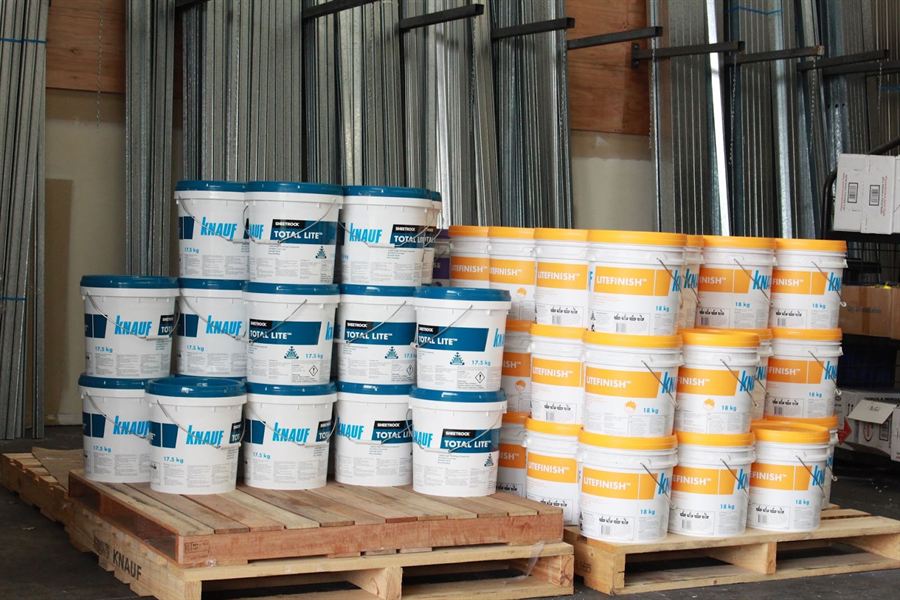
What are the main types of jointing compound?
Setting-type compound, also called base coat or hardset, comes as a powder and is mixed with water on site. It hardens by a chemical reaction rather than by drying, so it sets in a fixed time regardless of the weather, shrinks very little and builds strength quickly. The number in the product name is the working time in minutes: USG Durabond 20, 45 and 90 are the familiar examples, and Knauf base coat and Sheetrock setting-type compounds work the same way. It is the compound for bedding tape, filling the recess and packing gaps and damaged edges.
All-purpose ready-mix comes wet in a bucket and dries by evaporation. It can be used for every coat, from taping through to finish, which makes it the simplest choice for small jobs and repairs. The trade-off is drying time, which stretches out in humid Brisbane weather, and more shrinkage than a setting compound, so it usually needs an extra pass on a deep recess. Knauf Tradesman joint compound is the all-purpose line we stock.
Topping and finishing compound is a lightweight, low-shrinkage, air-drying compound designed for the last coat. It spreads thin, feathers out wide and sands to dust with little effort. It is not designed to bed tape and should not be used for the first coat. Knauf ready-mix jointing compound, Litefinish and Knauf Multi-Finish gypsum plaster sit in this group, with Multi-Finish suited to a full skim coat over board or old plaster.
Which compound goes on which coat?
| Coat | Job | Compound | Why |
|---|---|---|---|
| 1. Tape coat | Bed the paper tape, fill the recess | Setting-type 45 or 90 | Strong bond, minimal shrinkage, next coat the same day |
| 2. Second coat | Fill over the tape, build the joint out | Setting-type or all-purpose | Setting for speed, all-purpose for easier sanding |
| 3. Finish coat | Feather wide, leave a paint-ready surface | Topping or finishing compound | Spreads thin, sands easily, low shrinkage |
| Screw heads | Two or three passes | Same compound as the joint coat | Keeps the sanding consistent |
| Level 5 skim | Thin coat over the whole sheet | Finishing compound or Multi-Finish | Evens out texture under critical light |
The number of coats and how far each is feathered is set by the finish level the specification calls for. Our guide to plasterboard jointing and finishing levels walks through Levels 3, 4 and 5 and where each is used.
Setting-type or ready-mix: which is faster?
Setting-type is faster on the wall and slower in the bucket. Because it sets chemically, a 45-minute compound is ready for the next coat in under two hours whatever the humidity, so a room can be taped and second-coated in a day. The cost is discipline: mix only what you will use inside the working time, because a batch that has started to set cannot be brought back with more water, and the mixing bucket has to be cleaned between batches or the residue kicks off the next one early.
Ready-mix is the opposite. Nothing is wasted, the lid goes back on, and a wet day just means waiting. Drying time is the real constraint: a second coat over an all-purpose compound that is not fully dry traps moisture and the joint can crack or bubble weeks later. On a production build in summer, most plasterers run setting compound for the first two coats and a finishing compound for the last, which is the combination the table above describes.
Is cornice cement a jointing compound?
No, and using it as one is a common mistake on small jobs. Cornice cement is a setting-type gypsum adhesive formulated to hold the weight of a cornice against the wall and ceiling while it cures, with enough body to fill the gap behind the cornice and to be tooled at the mitres. It sets faster and harder than a jointing base coat and it sands badly, which is exactly why it makes a poor joint filler. Knauf cornice cement is the standard product and Knauf Cornice Fix is the fast-set alternative for production work where the cornice goes up the same morning the board does.
How much cement a room needs depends on the cornice profile and the metres involved, and our guide to cornice sizes and how much to order covers the linear-metre calculation and the adhesive coverage.
Stud adhesive or screws?
Both, on most walls. The standard Australian method for fixing plasterboard to walls is daubs of stud adhesive on the framing plus screws around the perimeter and at intervals in the field. The adhesive does the holding, the screws hold the sheet tight while the adhesive cures and take the load at the edges where the sheet is most likely to move. That combination means far fewer screw heads to set and sand than a screw-only wall.
The exceptions matter. Fire-rated and acoustic walls are built to a tested system, and many of those systems are screw-only at a specified spacing, so check the system before reaching for the adhesive. Ceilings are screw-fixed. Wet area walls follow the board manufacturer’s instructions. Stud adhesive is not a jointing compound and jointing compound is not an adhesive, so keep them on separate lines of the order. We stock Adseal polymer stud adhesive for timber and light-gauge steel, and Sika SikaBond for direct-fix applications.
How much compound does a job need?
Coverage varies with the recess depth, the finish level and the plasterer, so treat these as planning figures and confirm against the product data sheet. A 20 kg bag of setting-type compound will typically tape and second-coat somewhere around 30 to 40 square metres of board. An 18 to 20 kg bucket of finishing compound will typically finish-coat 40 to 50 square metres. Level 5 skims use considerably more topping compound because the whole sheet is coated, not just the joints.
- Setting-type base coat, 45 or 90 minute, for tape and second coats
- Finishing or topping compound for the last coat and screw heads
- Paper jointing tape, plus mesh tape if any repairs or fibre cement joints are in scope
- Cornice cement matched to the cornice metres on the order
- Stud adhesive for the wall sheets, with the screw count reduced to suit
- Corner beads and external angles, which the finish coat has to cover
Store bags off the concrete and dry, because setting compound that has drawn moisture will not mix properly, and keep ready-mix out of the sun on site so the lid seal holds. A bucket that has skinned over can usually be stirred back, a bag that has gone lumpy cannot.
Getting compounds and adhesives supplied in South East Queensland
Bayside stocks the full run of compounds, cornice cement and adhesives from Knauf, USG and Sika at all four yards, so the compound goes on the truck with the board rather than on a separate trip. Tell the trade counter the square metres of board and the finish level and we will work back to a bag and bucket count.
Call (07) 3245 4488 or send the job details through and we will price the board, the compounds and the delivery together.
Need the compounds on the same truck as the board?
Send Bayside Plasterboard the board quantity and the finish level, and we will add the right base coat, topping, cornice cement and adhesive to the order for delivery across South East Queensland.
Get a compounds quote →