
The right plasterboard sheet length is the shortest length that covers the wall or ceiling run in one sheet. Fewer butt joins means less finishing and less waste. We stock Sheetrock One in lengths from 2400mm to 6000mm, so match the length to the wall run or the ceiling span, then list each length on your materials list. Confirm longer lengths by phone.
Plasterboard sheet lengths decide how many joins end up on your walls and ceilings, and a butt join is the hardest join to finish flat. This guide covers how to pick a length for each wall and ceiling, how fixing direction changes the answer, and how to write lengths on a materials list. For thickness and weight figures, see our thickness, sheet size and weight reference. For quantities, see how much plasterboard you need.
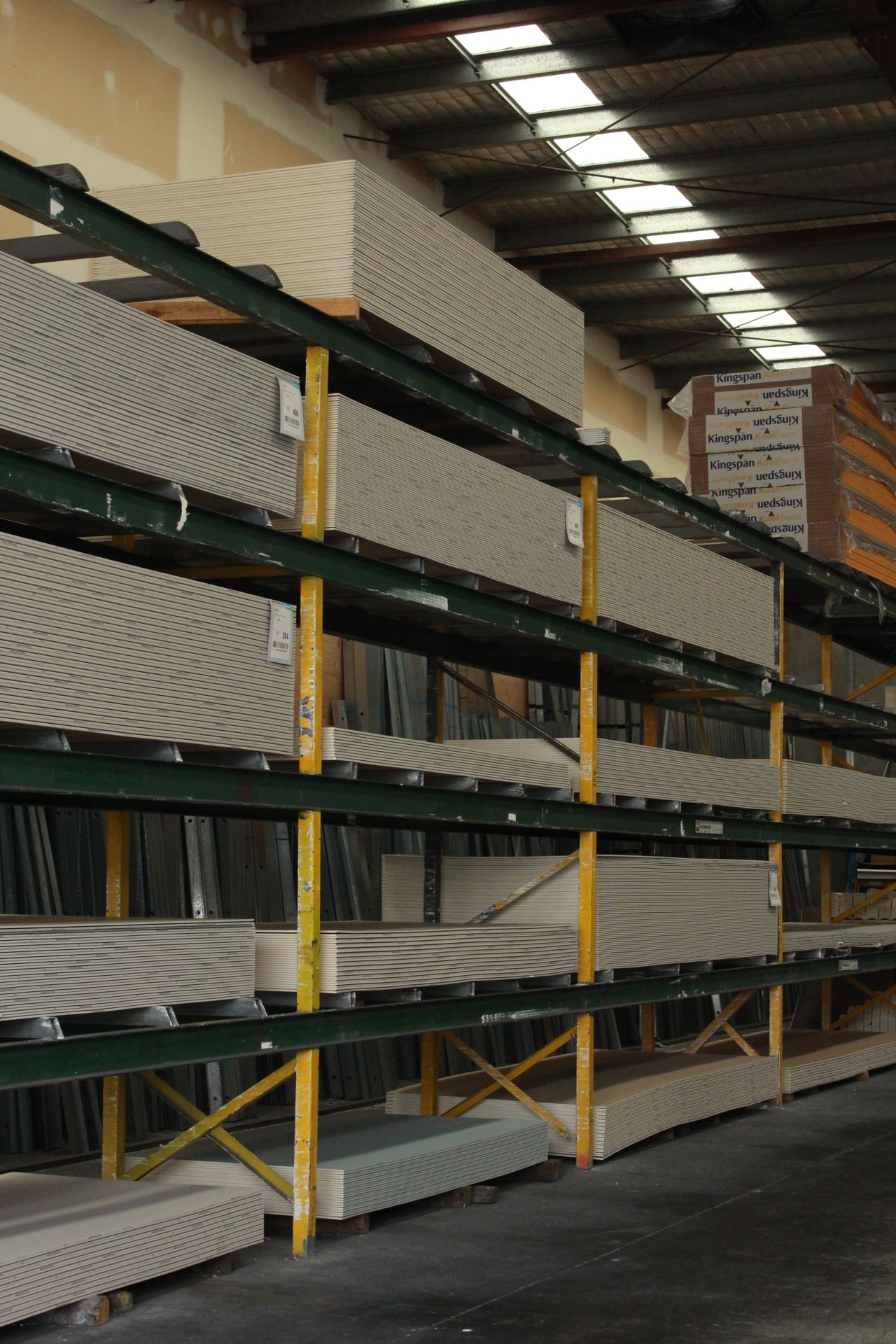
What plasterboard sheet lengths does Bayside stock?
Sheet width is 1200mm for standard board, which suits framing at 600mm centres. Knauf also lists 1350mm sheets, which suit 450mm centres, and Impactstop is stocked in 1200mm and 1350mm widths. Length is where you have a choice. Our stock list shows Sheetrock One in 10mm and 13mm, in lengths from 2400mm to 6000mm, and the table below sets out the common ones. Other boards come in their own lengths, and longer lengths are best confirmed by phone. Our Knauf range guide shows what each board line is for, and our types of plasterboard page covers the grades.
| Sheet length | Where it tends to suit |
|---|---|
| 2400mm | Walls and ceilings at 2400mm height. The easiest length to carry and turn in a tight room. |
| 2700mm | Raised ceilings and full-height vertical sheets on 2700mm walls. |
| 3000mm | Medium rooms, stairwells and walls that run longer than they are high. |
| 3600mm | Long horizontal runs on walls, and ceilings in wider rooms. |
| 4200mm | Larger rooms and long wall runs where one sheet can span the whole length. |
| Up to 6000mm | Long open ceilings and big walls. Confirm stock with the yard before you drive out. |
How do you match sheet length to wall height?
Start with the wall. If the wall is 2400mm high, a 2400mm sheet fixed vertically covers it floor to ceiling with no butt join. A 2700mm wall takes a 2700mm sheet. Order a length shorter than the wall and you create a join across it that needs backing and extra finishing. Order one much longer and you cut off a strip that goes to the bin.
The Knauf installation manual says to minimise butt joins by using long sheets. A house is rarely one clean height, though. Raked ceilings, stairwells and voids each need their own length, so measure each wall run and write it down before you call.
Should you fix plasterboard horizontally or vertically?
Both are normal practice, and the choice changes which length you order. The Knauf Plasterboard Installation Manual gives horizontal fixing as the preferred wall layout where a Level 4 or 5 finish is wanted. Fixed horizontally, the sheet runs along the wall. A 1200mm wide sheet covers half of a 2400mm wall, so two courses finish the height with one long recessed join between them. That join is easier to finish than a butt join.
The sheet length then needs to match the length of the wall. A 3600mm sheet fixed horizontally covers a 3600mm wall with no end join. Fixed vertically, the sheet length matches the wall height, and you count sheets across the width of the wall instead.
Horizontal fixing tends to suit long, clear walls. Vertical fixing tends to suit short walls, narrow returns and spots where a long sheet will not fit through the building. Where windows or doors interrupt the wall, plan the joins to keep them clear of the opening edges.
How do you choose plasterboard sheet lengths for a ceiling?
Knauf says to sheet ceilings perpendicular to the framing, and to minimise butt joins by using the longest sheet possible. So the sheet runs across the battens or joists, and the length you want is the room dimension in that direction. Check your batten centres against the data sheet for the board before you order.
Take a bedroom 3.6m by 4.2m with the battens running along the 3.6m side. The sheets run across them, in the 4.2m direction. Three 4200mm sheets, each 1200mm wide, cover the ceiling with no butt join at all. With 3600mm sheets you would have butt joins in the room. The Knauf manual says that at a Level 4 or 5 finish, butt joins float centrally between framing members and are back-blocked, so each one adds work. Not every room works out this neatly, but a longer sheet and a trim is often a better call than an extra join.
A worked example: one wall, two ways
Take a wall 4200mm long and 2400mm high. Fixed horizontally, two 4200mm sheets give two courses, one recessed join along the middle and no butt joins. Fixed vertically with 2400mm sheets, you need four sheets, because 4200mm divided by 1200mm is 3.5. The last sheet is cut down, and you have a join every 1200mm to finish.
The horizontal option uses fewer sheets, and you carry fewer, longer sheets to the room. The vertical option uses shorter sheets that handle more easily. Pick the one that suits the site. The sums are the same on any wall: wall length divided by sheet width for vertical, and wall height divided by sheet width for horizontal.
How do you stagger butt joins between sheets?
Some butt joins stay, usually on long walls and big ceilings. The Knauf manual says to stagger butt joins on adjoining sheets. Plan the stagger when you choose lengths, not when the sheet is on the wall. A run of 3600mm sheets with a 3000mm sheet at the start of the second course staggers itself.
Back-blocking is a strip of board fixed behind a join to support it. The installation standard AS/NZS 2589 sets the requirements for finishing levels and back-blocking, and the Knauf manual follows it. Level 4 is the default finish. If a job needs Level 5, ask your plasterer about back-blocking before you finalise lengths.
How do handling and access change the length you order?
The longest sheet is not always the right one. A 4200mm or 6000mm sheet has to get from the truck to the room. Check the stairs, the turns, the door widths and the ceiling heights along the way. A long sheet that will not turn a corner in a hallway ends up cut on the driveway.
Weight matters too. A longer sheet of thicker board is a two-person lift, and our spec reference has the weights. Tell us about access when you order, and see our delivery and pick-up page for the options.
How do you list sheet lengths on a materials list?
Bayside quotes from a materials list. We do not work from plans or measure up for you, so the list you send sets the quote. Write each line with four items: board name, thickness, sheet length and number of sheets. For example, Sheetrock One, 13mm, 4200mm, 18 sheets.
Keep walls and ceilings on separate lines when the thickness or length differs. If one room needs 2700mm sheets and the rest need 2400mm, list them separately so the right lengths come on the truck. Add a line for any wet area, fire-rated or acoustic board, because those are different products. Our plasterboard quantity guide sets out how to work out the number of sheets and the allowance for waste.
Add screws, compound, cornice and beads to the same list, and note any access limits. Our plaster supplies page lists the rest of the trade counter. The National Construction Code, published by the Australian Building Codes Board, sets where particular linings are required, so check the code or your certifier before you swap a board type to suit a length.
Which yard do you order from?
Bayside has four yards in South East Queensland: Morningside in Brisbane, Chandler in the Redlands, Caboolture on the northside and Carrara on the Gold Coast. The standard 10mm and 13mm boards in the common lengths are held at each yard. Longer lengths are best confirmed by phone before you drive out. Call (07) 3245 4488 with your list and we will tell you what is on the rack.
Sheet lengths worked out?
Send Bayside Plasterboard your materials list with board, thickness, sheet length and quantity, and we will quote the order for delivery or pick-up in South East Queensland.
Get a plasterboard quote →